
The AI Mirage · Feature · July 2026
The Confidence Trap
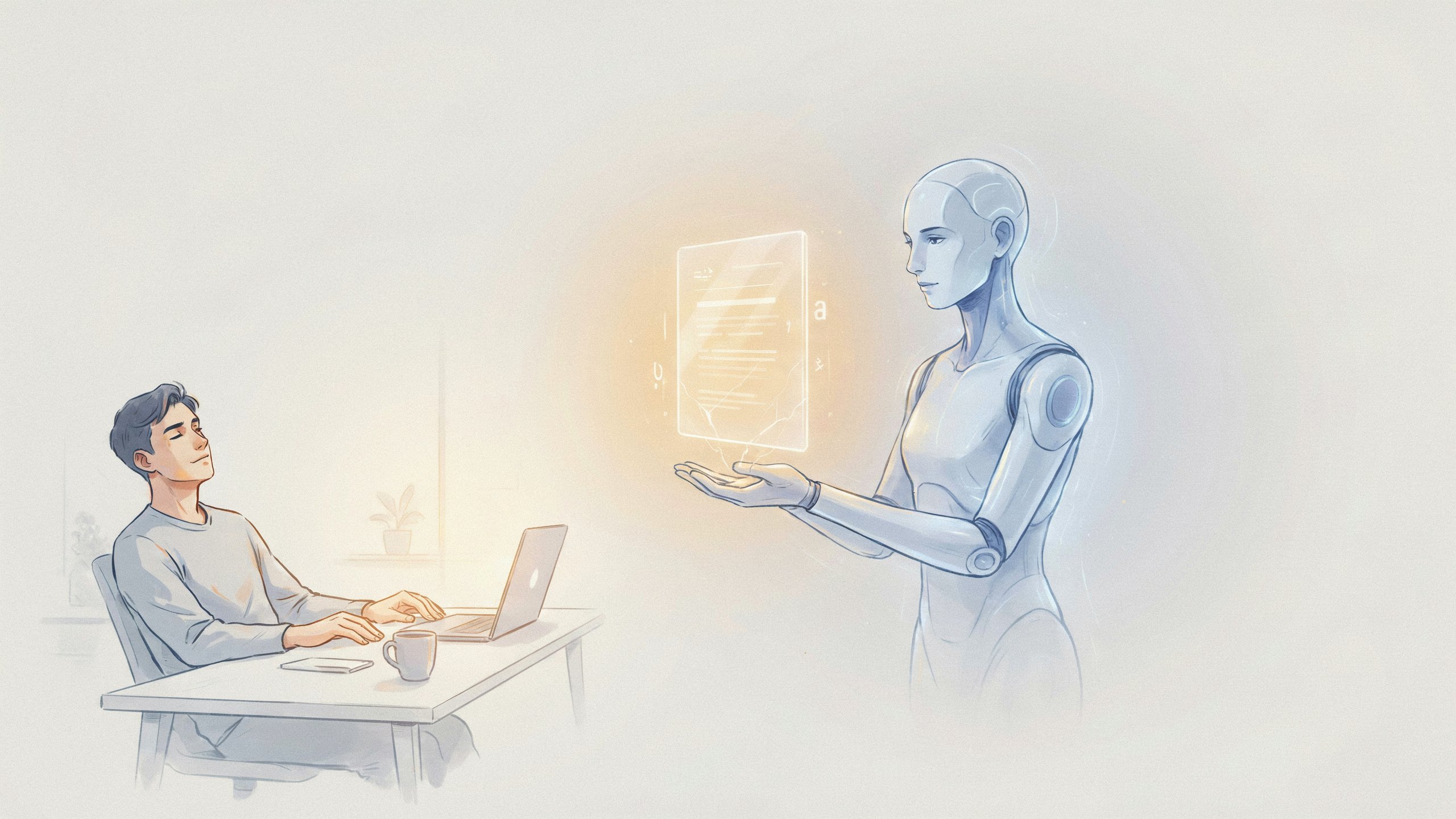
The danger isn't that AI is wrong. It's that AI is wrong fluently — and fluency is exactly what disarms the humans who were supposed to catch it.
Picture two wrong answers. The first is garbled — misspelled, rambling, obviously broken. You catch it instantly and move on. The second is crisp, well-structured, footnoted, and delivered in the calm register of an expert. It is also completely false. Which one costs you money? Not the garbled one; you threw that away. It's the polished one — the answer so fluent that nobody thought to check it — that ends up in the board deck, the customer email, the regulatory filing. This is the confidence trap, and it is the single most under-appreciated risk in enterprise AI. The problem was never that models are wrong. It's that they're wrong convincingly.
01 — The Core DefectConfidence and correctness have come apart
In a healthy human expert, confidence and competence are loosely coupled. A good analyst hedges when unsure, and that hesitation is a signal — it tells you where to look harder. Large language models have severed that link. They produce their best guess and their worst guess in exactly the same authoritative tone. The prose is just as smooth, the structure just as clean, the certainty just as total. There is no tremor in the voice when the model leaves the edge of what it knows and starts to invent.
Engineers have a precise word for this: calibration. A well-calibrated system that says it's 70% sure is right about 70% of the time. Here's the uncomfortable finding from the labs themselves. OpenAI's own GPT-4 technical report showed that the raw pre-trained model was remarkably well-calibrated — its confidence tracked its accuracy. But the post-training that makes models helpful and agreeable — RLHF — measurably degraded that calibration. A growing body of research (for example, "Taming Overconfidence in LLMs," 2024) has since shown that the very process we use to make models pleasant to talk to also makes them systematically overconfident. We optimized for a good conversational partner and got a witness who never admits doubt.
This is why the trap is structural, not incidental. It's not that models are occasionally overconfident the way a person might be. Overconfidence is baked into the layer that makes them commercially useful. And that means you cannot read a model's tone as a signal of anything. The fluency is free. It costs the model nothing to be eloquent about a fact it just fabricated.
02 — The Human WeaknessWhy fluency disarms us
The model's overconfidence would be harmless if humans discounted it. We don't. Decades of psychology show that people use fluency as a proxy for truth — information that is easy to process feels more accurate, and confident delivery reads as competence. Pair that with automation bias, our documented tendency to over-trust a machine's output, and you have a perfect failure mode: a system engineered to sound certain, meeting a human wired to believe certainty.
The result is that the safety net everyone assumes is in place — "a person will check it" — is precisely the mechanism the trap defeats. A clumsy error trips the reviewer's instinct; something looks off, so they dig. A fluent error soothes the reviewer's instinct. It matches their mental template of what a correct answer looks like, so they nod it through. The better the model gets at prose, the more dangerous its errors become, because polish is the very thing that switches off human scrutiny.
This is not hypothetical. When independent testers probed Microsoft's Copilot on election questions, it delivered wrong dates and invented quotes in roughly a third of answers — stated, as always, with total composure. When the AI coding tool Cursor's support bot confidently announced a login policy that did not exist, developers didn't pause to doubt a clear, assured answer; they cancelled their subscriptions. In each case the failure wasn't a garbled output a human would obviously catch. It was a confident, coherent falsehood that looked exactly like the truth.
There's a deeper reason leaders in particular are vulnerable. The higher you sit, the more you consume information as summaries — distilled, confident, decision-ready. That is precisely the format in which the confidence trap is most effective, because a summary strips away the hedges, caveats, and raw sources that would let you assess certainty for yourself. An executive reading a polished one-paragraph brief has almost no surface on which to detect a fabrication; they are receiving the model at its most fluent and least checkable. The seniority that should bring more scrutiny often brings less, simply because of the shape in which the information arrives.
03 — The Blast RadiusWhere the trap does the most damage
The confidence trap is not uniformly dangerous. Its cost scales with two things: how consequential the decision is, and how hard the error is to notice. The worst quadrant is where both are high — a wrong number that looks right, feeding a decision that matters.
- Numbers in the deck. A fabricated statistic or a misread figure in a board or investor document. It looks authoritative, so no one re-derives it — until someone external does.
- Customer-facing answers. Policy, pricing, eligibility. The Air Canada tribunal established the principle bluntly: your bot's confident invention becomes your company's binding statement.
- Regulated and legal content. Citations, compliance claims, medical or financial guidance — domains where a fluent fabrication carries fines, sanctions, or real harm.
- Chained automation. When one agent's confident-but-wrong output becomes another agent's trusted input, error doesn't just occur — it compounds, silently, with no human between the links.
The unifying thread is the absence of a natural check. In each case the output is plausible enough to skip verification and important enough that skipping it hurts. Low-stakes uses — brainstorming, first drafts, internal summaries — are nearly immune, because a wrong answer is cheap and a human is already in the loop. The executive skill isn't fearing the trap everywhere. It's knowing exactly which quadrant a given use case sits in.
The tell for leaders
Be most suspicious of the AI output that impresses you most. If an answer is so clean and confident that you feel no urge to check it, that is not evidence it's correct — it's the exact condition under which the confidence trap does its work.
04 — The MultiplierWhen confident agents talk to each other
Everything above assumes a human is somewhere near the output. The fastest-growing pattern in enterprise AI removes that assumption. In an agentic system — a coordinator delegating to a research agent, a scheduling agent, a compliance agent, a context agent — the output of one model becomes the input to the next, with no human between the links. This is where the confidence trap stops being a risk and becomes a multiplier.
Here's the mechanism. A research agent produces a confident, plausible, and subtly wrong figure. Because it arrives with no tremor of doubt, the coordinator has no reason to distrust it and passes it to a downstream agent as an established fact. That agent reasons on top of it, adds its own fluent layer, and hands the result along. By the time an answer reaches a human — if one is even in the loop — the original error is buried three steps deep, wrapped in three layers of confident prose, and effectively impossible to trace. The system didn't catch the mistake; it laundered it.
What makes this so dangerous is that agentic architectures are usually sold on the promise of removing human bottlenecks — that's the point of delegated autonomy. But autonomy without calibration means every handoff is an act of blind faith. The chain is only as trustworthy as its least-checked link, and in a fluent system every link looks trustworthy. This is why the serious agent frameworks put verification at the boundaries: a compliance agent whose entire job is to distrust the others, confidence thresholds that force a low-certainty result back to a human, and audit trails that let you reconstruct which agent introduced which claim. Delegated autonomy is only safe inside boundaries that assume the agents will sometimes be confidently wrong.
05 — The CountermeasuresDesigning for doubt
You cannot make the model humble. But you can build a system around it that manufactures the doubt the model refuses to express. Four moves do most of the work.
First, surface uncertainty as data, not tone. Where the model can produce a genuine confidence estimate or a self-consistency signal, expose it — and route low-confidence answers to a human. Second, demand citations: an answer grounded in a retrievable source can be checked in seconds, and grounding is the single most effective structural defense against fabrication. Third, make "I don't know" a first-class answer. Most systems implicitly punish abstention — the model always produces something. Explicitly rewarding a calibrated "I'm not sure, here's who to ask" is often worth more than a marginally better model. Fourth, verify independently: for high-stakes output, a second model or a rules check acts as an adversarial reviewer that isn't seduced by the first one's polish.
Notice what these have in common. None of them tries to make the model more honest — that battle is lost at the training layer. They accept the model as a fluent, overconfident narrator and wrap it in a system that trusts nothing on tone alone. That is the mental shift: stop asking "how do I get the model to stop being so sure?" and start asking "how do I build a process that never mistakes confidence for correctness?"
A final, cultural point. These countermeasures only work if the organization stops treating a confident answer as a finished one. That means praising the analyst who says "the model gave me a number but I couldn't verify the source, so I flagged it" instead of the one who simply shipped the polished result faster. The confidence trap is ultimately a human habit dressed up as a technical problem, and the antidote is a team that has been taught to feel more suspicion, not less, precisely when the output looks flawless.
The TakeawayTrust the process, never the tone
The confidence trap is the mirage at close range: an answer that shimmers with authority right up until you test it. Because overconfidence is baked into how modern models are trained, and because humans are wired to equate fluency with truth, the smoothest output is the most dangerous — it disarms the very review that should catch it. Leaders can't fix the model's swagger, but they can refuse to let it substitute for proof: surface real uncertainty, demand citations, reward "I don't know," and verify independently before anything consequential ships. The discipline is simple to state and hard to hold — judge AI output by evidence, never by how sure it sounds.
From ANCI AI
Agents built to distrust their own confidence
ANCI builds AI agents the way this article argues you should deploy them — grounded in retrievable sources, routed to a human when confidence is low, and gated by an independent check before anything consequential ships. Fluency is never mistaken for proof.
Explore ANCI
Sources: OpenAI, GPT-4 Technical Report, 2023 (post-training/RLHF degrades calibration); "Taming Overconfidence in LLMs: Reward Calibration in RLHF," arXiv:2410.09724, 2024; research on fluency heuristics and automation bias; independent testing of Microsoft Copilot on election queries, 2024; Cursor support-bot incident, 2025; Moffatt v. Air Canada, 2024.
Article 2 of 10 · The AI Mirage · AI Edge for Leaders.