Anatomy of an Agent at Work
Why AI agents are becoming the coworkers we never knew we needed — a look inside the goals, memory, planning, tools, feedback, and trust that turn a language model into a genuinely useful teammate.

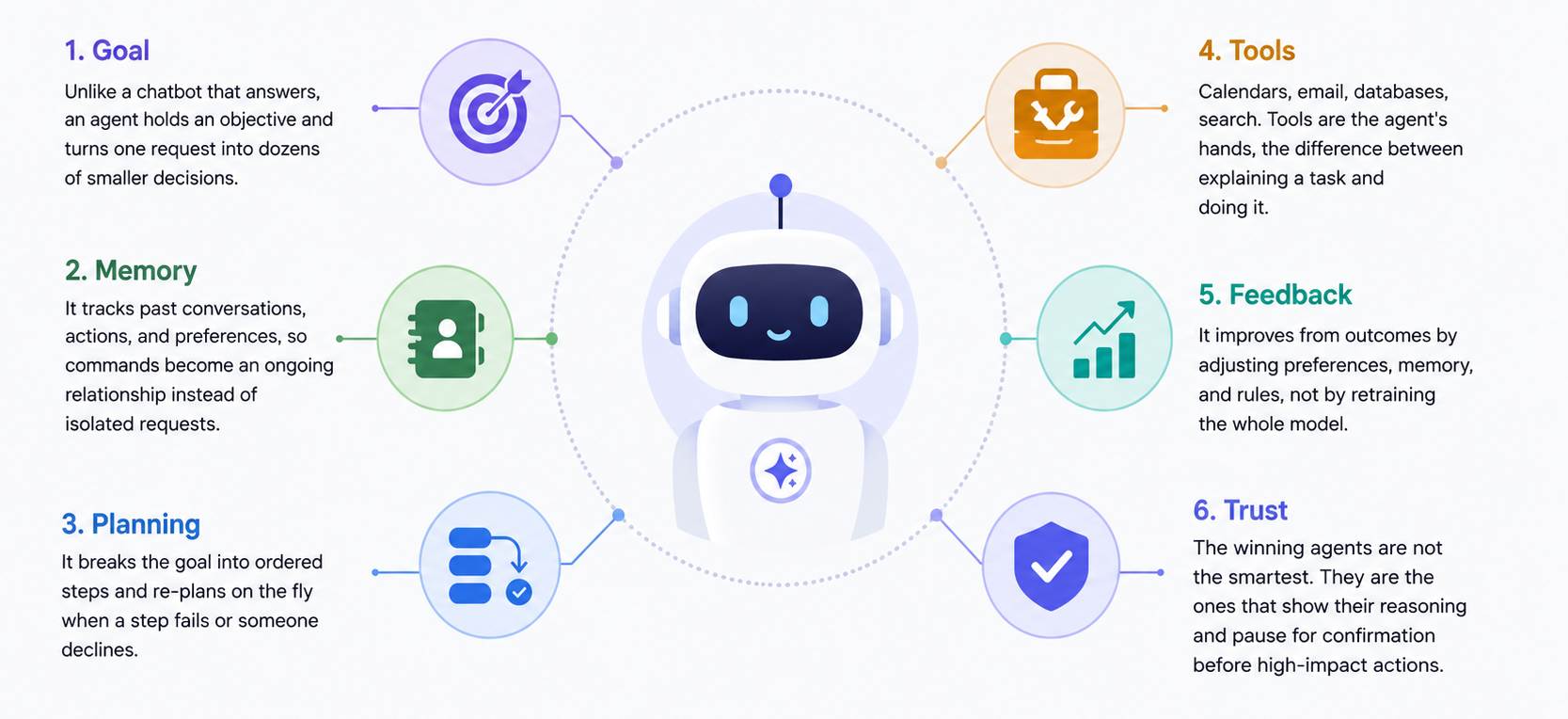
When people hear the phrase AI agent, they often imagine something futuristic — a humanoid robot walking through an office, or a digital assistant that somehow knows everything. The reality is much less dramatic, yet far more interesting. An AI agent is less like a robot and more like an incredibly reliable teammate. It listens, plans, makes decisions, uses tools, and adapts when things don't go as expected.
The more I learn about AI agents, the more I realize they aren't replacing the idea of work — they're changing how work gets done. Instead of spending hours clicking through software, copying information between applications, or handling repetitive administrative tasks, people can increasingly hand those responsibilities to an agent. What remains is the work humans tend to enjoy most: solving problems, building relationships, and making creative decisions.
After spending time building scheduling assistants and experimenting with AI-powered workflows, I've started thinking less about what an AI model knows and more about how an AI agent behaves. Intelligence is only one piece of the puzzle. The real magic comes from how all the pieces work together.
01 — The GoalEvery agent starts with a goal
At its core, every AI agent exists for one reason: to accomplish a goal. Unlike a chatbot that simply answers questions, an agent has an objective. Maybe it's scheduling a meeting, organizing emails, processing invoices, or helping a customer support team resolve tickets.
Think about asking an assistant: "Schedule a 45-minute meeting with everyone on my team next week." To us, that's one sentence. To an AI agent, it's an entire project. It has to understand what you asked, determine everyone's availability, check calendars, compare time zones, identify conflicts, rank possible meeting times, send invitations, and confirm success. That single request turns into dozens of smaller decisions.
I think this is one of the biggest misconceptions people have about AI. They assume intelligence comes from generating impressive text. In reality, useful AI often comes from breaking a complicated task into hundreds of tiny decisions that all happen behind the scenes.
02 — MemoryMemory makes agents feel intelligent
One of the first things I noticed while working with AI scheduling assistants is how frustrating conversations become when nothing is remembered. Imagine telling someone, "Move tomorrow's meeting to Friday," and every single time they reply, "Which meeting?" The conversation feels exhausting.
Humans naturally rely on context. We remember what was discussed thirty seconds ago. Good AI agents do the same. An agent keeps track of previous conversations, completed actions, user preferences, and ongoing tasks. It knows which meeting you're referring to, which coworkers you frequently collaborate with, and even your preferred meeting lengths. Memory transforms an interaction from a series of isolated commands into an ongoing relationship.
Of course, memory also introduces challenges. Agents need to remember enough to be helpful without holding onto information that shouldn't persist forever. Finding that balance is one of the most fascinating engineering problems in AI today.
03 — PlanningPlanning is where the real thinking happens
Once an agent understands its goal, it has to create a plan. This step reminds me a lot of solving programming assignments in college. Whenever I jumped directly into writing code, I'd usually end up rewriting everything halfway through. But when I spent ten minutes planning first, the implementation became dramatically easier.
AI agents operate the same way. Instead of immediately taking action, they break problems into manageable steps. For a scheduling assistant, the plan might look something like this:
- Identify the participants.
- Retrieve everyone's calendar availability.
- Remove conflicting time slots.
- Rank the possible meeting windows.
- Generate the invitations.
- Notify the participants.
- Handle follow-up changes if someone declines.
What's interesting is that this planning often happens dynamically. If something unexpected occurs — someone becomes unavailable, or a calendar API fails — the agent doesn't simply stop working. It adjusts the plan and keeps moving toward the original goal. That's surprisingly human.
04 — ToolsTools turn intelligence into action
An AI model by itself only produces text. An AI agent, however, can use tools — and this distinction is huge. Without tools, an agent can explain how to schedule a meeting. With tools, it can actually schedule one.
Modern agents connect to calendars, databases, email providers, messaging platforms, web search, spreadsheets, customer relationship management systems, and internal company software. In many ways, tools are the agent's hands.
I've always found this part the most exciting, because it's where AI stops being conversational and starts becoming genuinely useful. Watching an agent call multiple services, retrieve information, make decisions, and complete a task feels much closer to automation than simply chatting with a language model.
05 — FeedbackFeedback keeps the agent improving
No system gets everything right the first time. Humans learn through feedback, and AI agents benefit from it as well. Sometimes an agent schedules a meeting that technically works but isn't ideal. Maybe it picks an early-morning slot when everyone usually prefers afternoons. Maybe it forgets that one employee always blocks off Fridays for focused work.
Feedback allows the agent to improve future decisions. This doesn't necessarily mean retraining an entire AI model. Sometimes it's as simple as adjusting preferences, updating memory, or modifying planning rules.
One thing I've learned while building software is that users almost always behave differently than you expect. No matter how carefully you design a workflow, someone will find a completely new way to use it. That's why the best AI agents aren't rigid. They're adaptable.
06 — TrustTrust is the feature that matters most
For all the excitement surrounding AI, I think trust is still the biggest challenge. Would you let an AI automatically email your boss? Approve expense reports? Reschedule an important client meeting? For many people, the answer is still "not yet" — and that's understandable.
The most successful AI agents won't necessarily be the smartest ones. They'll be the ones people trust.
That means showing their reasoning when appropriate, asking for confirmation before taking high-impact actions, recovering gracefully from mistakes, and knowing when to hand control back to a human. In my opinion, confidence without transparency is one of the fastest ways for an AI system to lose credibility.
07 — The EcosystemThe future isn't one giant agent
People often imagine a single AI that handles everything. I actually think the future looks different. Instead of one enormous assistant, we'll likely have specialized agents working together. One manages calendars. Another analyzes documents. Another handles customer support. Another monitors infrastructure.
Together they form an ecosystem where each agent focuses on what it does best while communicating with the others when needed. It's remarkably similar to how human teams operate today. No single employee knows everything, but a coordinated group can accomplish extraordinary things.
08 — Final ThoughtsThe anatomy of meaningful work
The anatomy of an AI agent isn't defined by one breakthrough technology. It's the combination of goals, memory, planning, tools, feedback, and trust that transforms a language model into something capable of meaningful work.
What excites me most isn't the possibility of replacing people — it's the opportunity to remove the repetitive, tedious tasks that consume so much of our day. If AI agents can handle scheduling, data entry, routine coordination, and countless other administrative responsibilities, people gain more time to focus on creativity, strategy, and collaboration.
We're still in the early days of agentic AI, and there's plenty of room for improvement. Agents will make mistakes, require oversight, and continue evolving. But after seeing how quickly they've progressed, it's hard not to imagine a future where working alongside AI agents feels as normal as sending an email or joining a video call.
The anatomy of an agent, in the end, isn't about artificial intelligence alone. It's about designing software that can understand objectives, adapt to changing situations, and genuinely help people get meaningful work done. That future feels closer than ever.
From the ANCI team
See an agent at work
ANCI builds AI scheduling agents that handle the back-and-forth of finding time across busy calendars — so the coordination disappears and the work commitment is all that's left. It's the connective layer this article is really about.
Explore ANCIGet AI scheduling insights, product news, and Bay Area community updates delivered to your inbox.
No spam. Unsubscribe anytime.