Sub-Agents: The Hidden Operating System Behind the Next Wave of AI-Driven Companies
Sub-agents are not just tools — they are specialized AI workers that operate under a larger agent, handling narrow responsibilities with autonomy. This executive guide explains what they are, why they represent a structural shift in how work gets done, and a five-step playbook with 11 prompts for launching your first one.

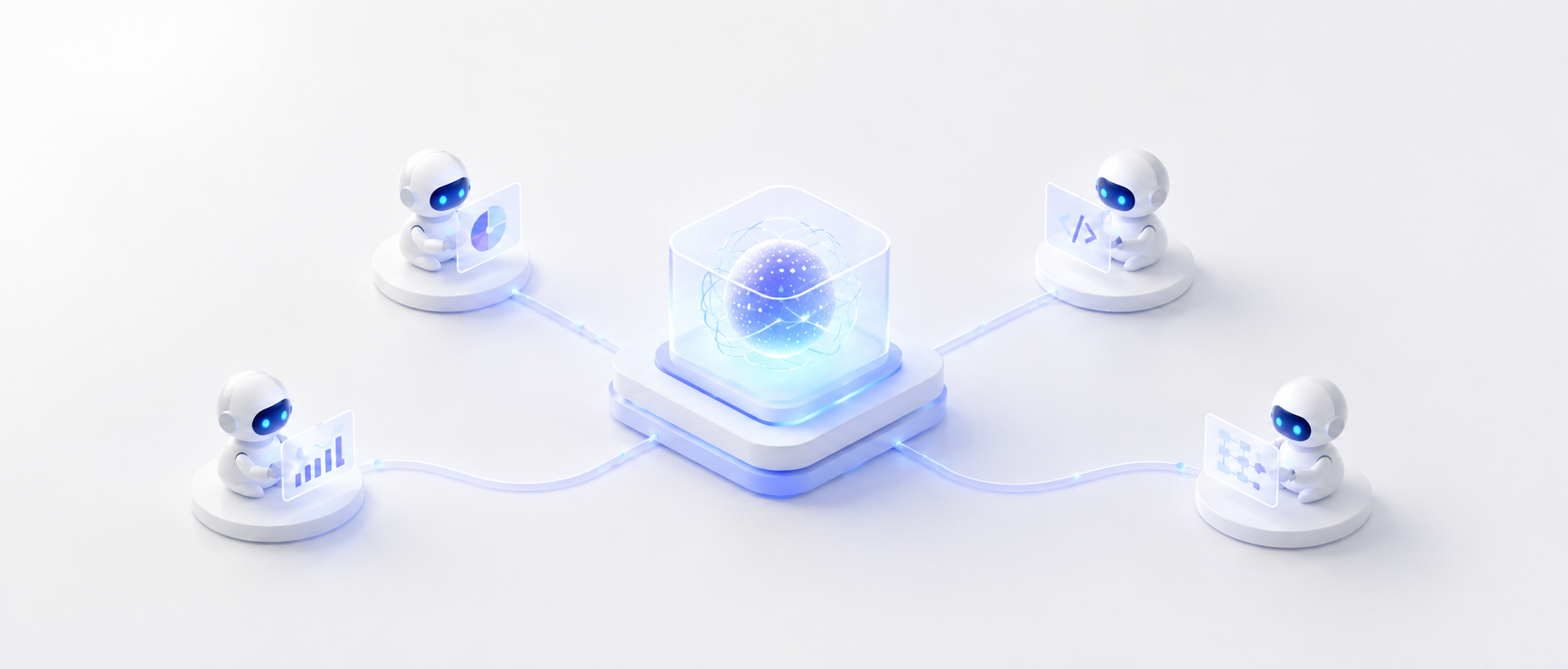
Most executives are experimenting with AI in familiar ways: chatbots for support, copilots for writing, automation for simple workflows. But something more structural is quietly emerging: sub-agents. These are not just tools. They are specialized AI workers that operate under a larger agent, handling narrow, high-context responsibilities with autonomy.
The shift matters because it changes how work is decomposed inside organizations. Instead of teams coordinating tasks across humans and software, we are moving toward systems where AI agents delegate to other AI agents, mirroring how modern companies already operate. For leaders, this is not a tooling upgrade. It is a redesign of execution itself.
01 / What Exactly Is a Sub-Agent?
A specialized AI worker with a contract, not a personality
A sub-agent is a specialized, task-focused AI agent that operates under the coordination of a primary agent. Think of it as a micro-worker inside an AI system, designed to handle a tightly scoped responsibility extremely well rather than trying to do everything.
If a primary agent is like a general manager, sub-agents are the functional specialists reporting into it: a scheduling sub-agent that resolves calendar conflicts, a research sub-agent that gathers and summarizes market intelligence, a compliance sub-agent that checks outputs against policy, a customer context sub-agent that retrieves relevant history before a response. The defining trait is delegated autonomy within boundaries.
Sub-agent architectures encode the delegation structure of a company directly into software. Each box is a contract, not a chatbot.
There are two complementary ways to define a sub-agent, and holding both at once is what makes the concept click. The first is by scope — the definition above: a specialized worker with a narrow mandate inside a larger system. The second is by context, and it is the more technical of the two. A sub-agent is a fresh instance of the same underlying model, running in its own clean context window. The "sub" is not a comment on its ability. It is the same model, given a blank page.
That second definition deserves unpacking, because the context window is where much of a sub-agent's value actually comes from. Picture the model working on a single sheet of paper. Everything you type goes on that sheet. Everything the model writes back goes on the same sheet. Your question, the document you pasted, the entire back-and-forth of a long conversation — all of it shares one page. The sheet is large but not infinite. When it fills, the oldest content slides off the top to make room.
A sub-agent grabs a clean sheet. It sees only the task it was handed — and none of the assumptions, dead ends, or blind spots that accumulated in the original conversation.
A sub-agent with a clean sheet reviews the way a colleague with fresh eyes spots the typo you read past ten times. An agent asked to review its own work reasons from the same context that produced it, and tends to inherit the same errors. A sub-agent sees neither the original work nor the reasoning behind it — only what you hand over.
The clearest way to understand the difference between a generic chatbot and a sub-agent is to see how each is instructed. A chatbot is given a personality. A sub-agent is given a contract. Notice what this example prompt does not contain — there is no open-ended goal, no instruction to "be helpful," no room to improvise. The agent's intelligence is bounded by an explicit contract: inputs, outputs, tools, constraints, and an escape hatch. That contract is the unit of design.
You are a Scheduling Sub-Agent. Your only job is to resolve
calendar conflicts for a five-person team.

Inputs you can see: the shared availability JSON, the meeting
request, and the priority tier of each attendee.
Outputs you must produce: one proposed time slot plus two
backups, in ISO 8601 format.
Tools you may call: get_availability(), check_room(), send_hold().
You must never: book a slot without an open room, double-book a
Tier-1 attendee, or schedule outside 08:00 to 18:00 local time.
If no valid slot exists, return STATUS: ESCALATE with the reason.
This structure mirrors a well-run organization. Large companies already function through layers of delegation: VPs, directors, managers, specialists. Sub-agents simply encode that hierarchy into software. By some estimates, a large share of tasks across knowledge roles — often cited in the range of 30 to 70 percent depending on the function — carries meaningful automation potential with current generative models. Sub-agents are the mechanism that turns that potential into execution.
02 / Why Executives Should Care
This is a structural shift in how work gets done
Most AI adoption so far has been horizontal: tools added on top of existing workflows. Sub-agents introduce something different — the vertical decomposition of work inside the software itself. This matters for four reasons.
First, it changes how execution scales. Instead of adding headcount to handle complexity, organizations can spawn additional sub-agents with narrow mandates. Execution becomes modular rather than linear.
Second, it changes where bottlenecks live. Today the bottleneck is human coordination and context switching. In a sub-agent architecture, the bottleneck moves toward system design: how cleanly tasks are decomposed and how reliably agents communicate. Agents do not coordinate through conversation — they coordinate through structured data, typically JSON payloads passed between a parent and its children, validated against a schema. When a handoff fails, it usually fails because the output format drifted, not because the model was not smart enough.
Third, it changes organizational design itself. Leaders will increasingly design workflows the way engineers design software: defining interfaces between agents rather than job descriptions for people.
Fourth, it makes genuinely independent review possible. Because each sub-agent runs in its own context, a reviewing agent does not share the blind spots of the agent that produced the work. This is the difference between proofreading your own draft and handing it to a colleague. For any output where correctness matters — code, financial figures, customer-facing language — a second agent with a clean context is a structurally better reviewer than the same agent that wrote it. Many of the most reliable agent systems are built on exactly this principle: one agent produces, a separate agent checks.
You are no longer managing teams that use AI. You are designing systems where AI agents manage work — including other AI agents.
The bottleneck moves from human coordination to interface design. When a handoff fails in a sub-agent system, it is almost always a schema mismatch, not a capability gap.
Before committing engineering time, most leaders benefit from a structured audit of their own workflows. A model is surprisingly good at performing the first pass.
Act as an operations analyst. Here is a recurring workflow in
my team: [paste a plain-language description of the workflow].

Break it into discrete sub-tasks. For each sub-task, label it:
- Decomposable (rule-based, narrow context, low judgment), or
- Human-required (high judgment, ambiguous, relationship-dependent).

Then list which decomposable sub-tasks could each be handled by
a single-purpose agent, and specify what inputs and tools each
one would need.
The output of that prompt is not a deployment plan. It is a map. It tells you where the modular boundaries in your work already exist — which is the prerequisite for designing anything around them.
03 / The Executive Playbook
Five steps to launching your first sub-agent
Launching a sub-agent does not begin with technology. It begins with choosing the right slice of work. Here is the sequence that separates a deployment that compounds in value from one that quietly rots.
The playbook in sequence. Most organizations skip Step 4 and Step 5 — which is exactly why their sub-agents stop improving after the first month.
Step 1 — Identify a repeatable micro-domain
Look for work that is frequent (daily or weekly), rule-based or semi-structured, dependent on context but not deep judgment, and currently causing coordination overhead. Examples: prepping meeting briefs from multiple sources, routing customer requests to the correct internal owner, or summarizing weekly pipeline changes across a CRM.
Review the following recurring tasks my team does each week:
[paste tasks].

Rank them for suitability as a sub-agent using these criteria,
scored 1 to 5 each: frequency, degree of structure, context
dependency (lower is better), and current human coordination
overhead.

Output a table with a score per criterion and a one-line
rationale for the top three candidates.
Step 2 — Define the boundary, not the intelligence
Most failures happen when teams try to make sub-agents too capable. Instead, define inputs (what it can see), outputs (what it must produce), tools (what it is allowed to call), and constraints (what it must never do). Think of it as a job description with hard rails, not an open-ended goal. That last line in the prompt below matters: a good specification surfaces its own missing dependencies before you ship it.
Write a sub-agent specification for this task: [task].

Use exactly these fields:
- Role (one sentence)
- Inputs (data and context it can access)
- Outputs (exact format and schema)
- Tools (allowed function calls)
- Hard constraints (things it must never do)
- Escalation rule (when and how it hands back to a human or
  parent agent)

Keep the role narrow. Do not add capabilities beyond the
stated task. Flag any input the agent would need but that I
have not provided.
Step 3 — Attach it to a primary agent
A sub-agent should rarely operate alone. It needs a coordinating parent agent that delegates tasks, resolves conflicts, aggregates outputs, and maintains context continuity. This is where orchestration matters more than model size. The logging requirement below is not a nice-to-have — in multi-agent systems, the delegation log is your primary debugging surface. When an output is wrong, the first question is always which agent produced it and what it was handed.
You are a Coordinator Agent managing three sub-agents:
ResearchAgent, DraftAgent, and ComplianceAgent.

For each incoming request:
1. Decide which sub-agents are needed and in what order.
2. Call each one with only the inputs it requires.
3. If ComplianceAgent returns FAIL, send the draft back to
   DraftAgent with the specific issue. Allow up to two retries.
4. Aggregate the results into one response, with a short summary
   of which agents were used and why.

Always log the full delegation path.
Step 4 — Start with shadow mode
Before granting full autonomy, run the sub-agent in parallel with the human workflow, compare outputs against the existing process, and measure the delta in speed, accuracy, and completeness. In most early deployments, the biggest gain is not automation — it is the compression of cognitive load for the humans involved.
I will paste ten real cases my team handled last month, each
with the human outcome included.

For each case, produce the sub-agent's output independently
without seeing the human answer first, then compare yours to the
human outcome on three axes: estimated speed, accuracy, and
completeness.

Summarize where the agent matched, where it diverged, and the
most likely cause of each divergence.
Step 5 — Close the loop with feedback signals
Sub-agents improve only when they are evaluated consistently. Define quality metrics (accuracy, completeness, time saved), failure categories (hallucination, missed context, wrong routing), and human override patterns. Without feedback loops, sub-agents degrade into brittle automation scripts. This is the step most organizations skip — and it is the one that separates a sub-agent that compounds in value from one that quietly rots.
Here are twenty outputs from the sub-agent, with human overrides
noted where they occurred: [paste].

Cluster the failures into categories: hallucination, missed
context, wrong routing, and format error.

For each category, estimate its frequency and propose one
specific change to the agent's instructions or constraints that
would reduce it. Rank the proposed changes by expected impact.
Beyond the first launch: three patterns worth trying early
The five steps above describe how to stand up a single sub-agent responsibly. Once that works, three patterns extend the idea quickly — and each maps directly to one of the strengths of an isolated context window.
Protect the main agent's context. Rather than dropping a long document into your working conversation and consuming the page, hand it to a sub-agent that reads it and returns only what you need. The main agent stays focused and uncluttered.
Spawn a sub-agent to read the attached 20-page report and
return only a one-page summary with the five key figures and
any stated risks. Do not return the full text.
Run work in parallel. Independent sub-tasks do not need to wait in line. Assigning one sub-agent per stream finishes a multi-part job in roughly the time of its slowest part rather than the sum of all parts. The gain here is wall-clock speed, not just flexibility.
Research our three fastest-growing competitors. Use one
sub-agent per competitor, running in parallel, each gathering
the same five data points. Return a single comparison table.
Convene a panel of specialists. Point several sub-agents at the same work, each adopting a different expert persona, and collect their independent verdicts. Because no agent sees another's context, the opinions are genuinely independent rather than an echo of the first one.
Review the attached sales page using three independent
sub-agents, each in its own context:
1. A B2B sales lead with ten years of experience.
2. A prospective buyer only mildly familiar with the product.
3. A copywriter who dislikes jargon.
Have each return its top three suggested changes, ranked by
impact. Do not let them see each other's responses.
In practice, patterns like the review panel are worth turning into a reusable, named routine rather than retyping each time — so the same panel can be summoned against any draft with one command.
04 / Dos and Don'ts
What to get right before you ship
- →Start narrow, then expand. The most effective sub-agents begin almost trivially small. Over-expansion early leads to unpredictable behavior and poor reliability.
- →Treat sub-agents like organizational roles. Give them clear responsibilities and explicit escalation rules. This improves both performance and interpretability.
- →Invest in orchestration design. The real power is not in any individual agent — it is in how they interact. Clean interfaces matter more than model sophistication.
- →Measure system-level outcomes. Evaluate end-to-end time reduction, reduction in human handoffs, and decision latency — not individual agent outputs in isolation.
- ×Turn sub-agents into mini-LLMs with no structure. More capability is not better. Unbounded agents introduce inconsistency and risk.
- ×Skip the boundary definition phase. Most failed deployments come from vague instructions. Sub-agents require precision, not improvisation.
- ×Ignore governance early. Even internal sub-agents can create compliance, security, or brand risk if left unchecked. Guardrails are not optional.
- ×Assume autonomy equals reliability. Autonomy without evaluation creates silent failure modes, especially in multi-agent systems where errors compound across handoffs.
- ×Ignore the token math. Every sub-agent runs in its own context window, so summoning five sub-agents consumes roughly five times the tokens. Parallel panels are powerful, but they are not free. Judgment about when the extra coverage is worth the cost matters more than maximizing the number of agents in play.
Before any sub-agent goes near production, it is worth deliberately trying to break it. A model makes a capable adversary against its own specification. Running the prompt below once will usually reveal more about the weaknesses of a specification than a week of careful drafting.
You are a red-team evaluator. Here is a sub-agent specification:
[paste the spec].

Generate ten edge-case inputs designed to make this agent
violate a constraint, exceed its scope, or produce an unsafe or
incorrect output.

For each input, predict how the current spec would respond and
whether the boundary holds. Where it fails, suggest the minimal
wording change to the spec that would close the gap.
The Takeaway
Value will not come from using AI at the edges of work.
It will come from decomposing the work itself into layers of coordinated agents.
Sub-agents are the first building block. The real skill is learning to write the contract.
ANCI AI Research & Insights · 2026
Get AI scheduling insights, product news, and Bay Area community updates delivered to your inbox.
No spam. Unsubscribe anytime.