One Sentence From Your Executive. Five Scheduling Problems.
What an executive assistant hears in a five-second request: a walkthrough of one sentence, the five problems inside it, and a carousel you can download and share.

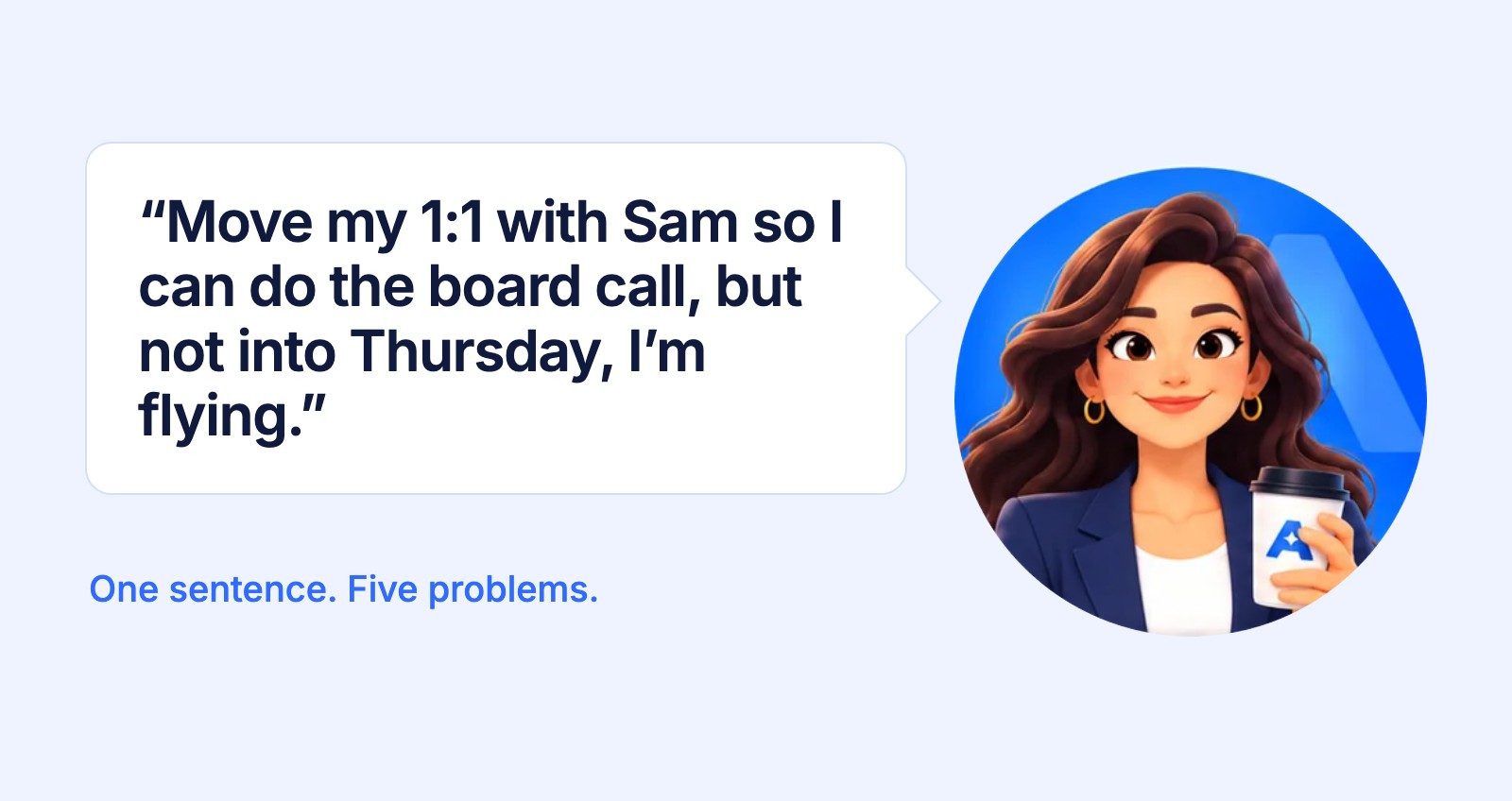
It takes an executive about five seconds to say this. It can take an executive assistant much longer to work out what it means.
That's an example we wrote, and it's simpler than the real ones EAs handle. Even so, one sentence holds five separate problems. Page through them below, or download the PDF to share.
1. The board call can't move
The executive named this one first, for a reason. It's the fixed point, and everything else gets arranged around it.
2. So the 1:1 has to
The sentence says what to move. It doesn't say where. The new time has to work for two people, and Sam hasn't been asked yet.
3. Sam is in London
Nothing in the sentence says so. The EA simply knows, and that changes everything. London is eight hours ahead of Pacific, so 8:30 am for the executive is 4:30 pm for Sam. The window where both are working is short.
4. Thursday is a travel day
The calendar might show Thursday as free. The executive just ruled it out, and that also rules out any time that depends on it.
5. Sam should know why
Finding the time isn't the end of the job. Nobody likes seeing a standing meeting move without an explanation. So a great EA moves the 1:1 to Wednesday morning Pacific, which is Wednesday afternoon for Sam, and tells Sam why.
What the example shows
None of those five problems is hard on its own. The skill is seeing them all at once, in a sentence that names only some of them. Some of it comes from the calendar. Much of it comes from knowing the people.
That's why we built ANCI, your AI scheduling agent, to take on the coordination: checking calendars, emailing guests, reading replies and handling changes. You keep the judgment calls, and nothing goes to a guest until you say so.
Send us a harder one
You've almost certainly handled something harder. Tell us what your executive said, what a great EA would do, and why. Every real situation helps us build ANCI for the job you actually do.
Get AI scheduling insights, product news, and Bay Area community updates delivered to your inbox.
No spam. Unsubscribe anytime.