It Took Almost Two Weeks to Schedule One Meeting. So We Built ANCI.
One customer meeting took almost two weeks to schedule. Why scheduling is a coordination problem, what we learned building ANCI for executive assistants, and where AI agents go next.

I was working at BILL.com when I tried to schedule a meeting with a customer through the customer's Executive Assistant.
It took almost two weeks.
Nobody was doing anything wrong. We had calendars, scheduling links, email and plenty of productivity software. Yet one meeting across two companies still took days of back-and-forth.
That made me ask a question I couldn't let go of. With everything technology can do, why does coordinating a simple meeting still take so much human effort?
We were solving the wrong problem
The scheduling industry has made real progress. Tools like Calendly made it easier to share availability. Calendars made it easier to see when people are free.
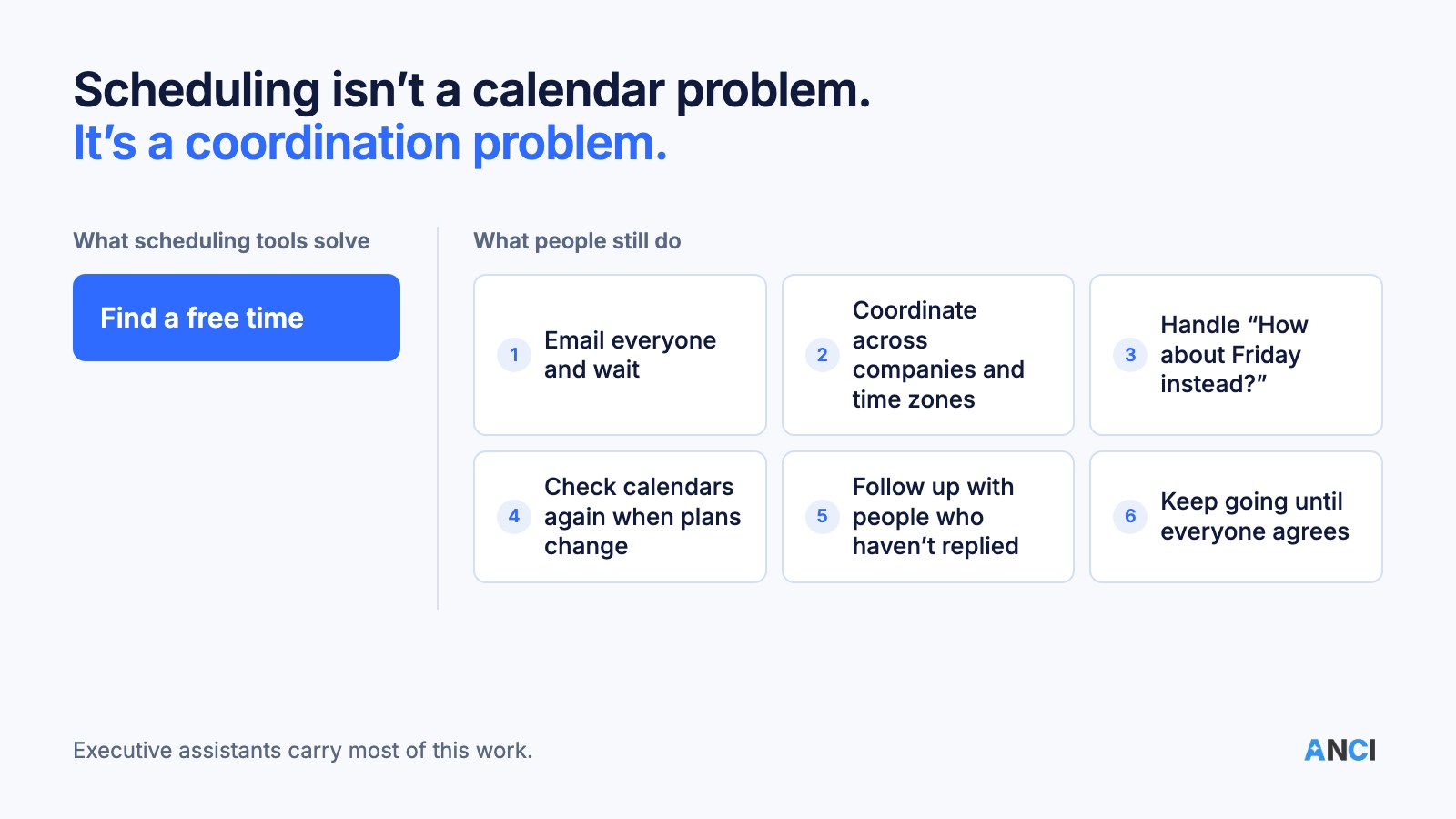
But finding an open slot is only one small part of the job. The real work comes after:
- Emailing participants and waiting for responses.
- Coordinating across companies and time zones.
- Handling other dates and counterproposals.
- Checking calendars again when plans change.
- Following up with people who haven't responded.
- Managing the conversation until everyone agrees.
The tools help people find a time. People still do most of the coordination.
Scheduling isn't really a calendar problem. It's a coordination problem. Executive Assistants carry most of it, and most people never see how much skill that takes.
What we learned by getting it wrong first
We started with TEAMCAL AI, a team scheduling platform that grew to about 3,000 users across 50 countries. Working with customers showed us how much time EAs spend coordinating meetings, especially when several people and organizations are involved.
We also learned that adding AI to a scheduling tool wasn't enough.
Our early AI agent pilots exposed the hard part: understanding a request and reliably carrying it out are very different things.
So we spent six months rethinking and rebuilding our AI architecture. We wanted an agent that could understand plain language, work across calendars and email, and handle changes, while keeping people in control of the decisions that matter.
That became ANCI.
Your Assistant Got an AI Assistant.
What ANCI does
ANCI is an AI scheduling agent that works for the Executive Assistant. It can:
- Understand a meeting request in plain language.
- Check availability across connected calendars.
- Email people outside the company, once the EA approves.
- Read replies and handle counterproposals.
- Bring any new time back to the EA, with the calendar already checked.
- Book the meeting on the executive's calendar.
Nothing goes to a guest until the EA says so. Every email comes from the EA's own address, with their name on it.
Great EAs anticipate needs, connect people, protect priorities and make judgment calls that software can't. We want them to have more time for that.
Where this goes
Today, one side of a meeting has an agent, and the other side gets an email.
I believe that will change. One day, your assistant's agent and the other company's agent will work out the meeting between themselves. They'll compare times, respect each side's preferences and bring back a time that works, in seconds, without days of back-and-forth.
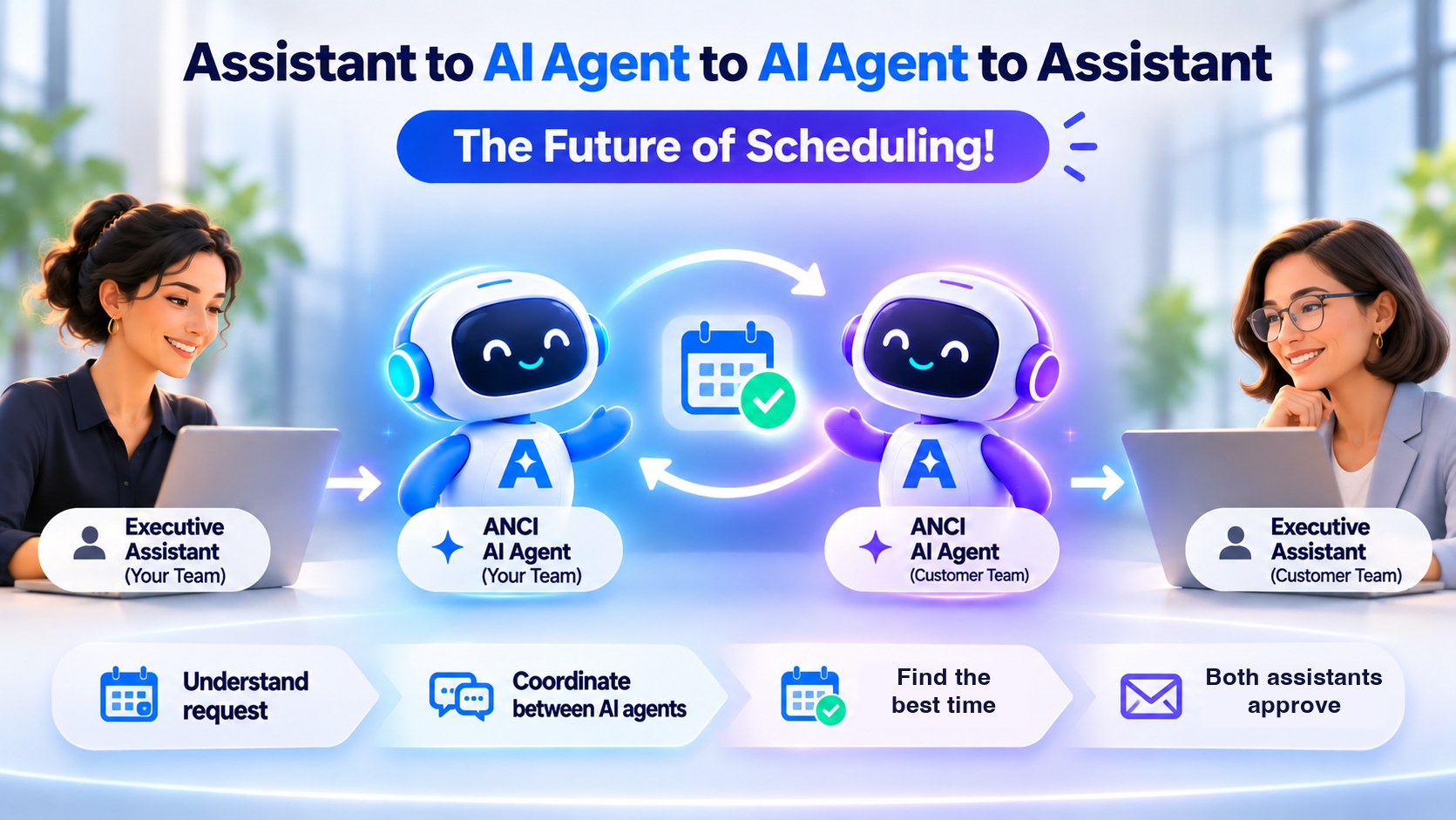
ANCI doesn't do that yet. Scheduling with people, one email at a time, is where we're starting.
And even when agents talk to agents, the decisions should stay with people. Your assistant will still know which meeting really matters and who can be asked to move. The agents will just handle the back-and-forth.
Remember that meeting that took almost two weeks? I want the next one to take seconds, with an EA still in charge.
If you're an Executive Assistant who spends too much time coordinating meetings across companies, I'd love to hear your story and show you what we're building.
See ANCI for executive assistantsGet AI scheduling insights, product news, and Bay Area community updates delivered to your inbox.
No spam. Unsubscribe anytime.